This article presents only general professional opinions and does not constitute legal, regulatory, financial, or compliance advice relating to your particular case. Reading it creates no consulting relationship with GRAYS™ Strategy. Figures come from the sources cited, as of the publication date, so please check them before you rely on them.
Your shortlist is probably full of technologies that would work. They all have demos, references, and roadmaps. None of them will tell you what will still fit your organization three years from now, once the demos are a distant memory and your team is living with the decision every day.
Agree on the outcomes together first
Before the first demo, ask the people who will use the technology, pay for it, and answer for it to write down what it is for. The answer might be a clinical result, an operational one, or a change in how a process runs. Then compare the answers. Gaps between them need settling before any option gets scored.
We believe this step has more impact on the result than any demo. If people have different outcomes in mind, then they’re going to score the same option differently, and the meeting can become a debate about the product. A single written list, agreed in advance, gives you a consistent basis for selection, go-live, and the first review of the results.
Recent research on digital interventions in health care points in a similar direction. A 2025 review of twelve studies found that clear communication of value, design that fits current workflows, user-focused training, and organizational readiness were named as facilitators of adoption (Patel et al., 2025). In our view, these are easy to describe but considerably harder to achieve cohesively, and that is where structured stakeholder alignment helps.
Establish your baseline
For each outcome, record its current status and the date. That could be a wait time or a cost per case. You can’t measure a gain that you’ve never recorded.
Score the options against those outcomes
Choose a few questions that are important for your outcomes, assign each a weight, and score every option from 1 to 5. A higher score is better on every question. The weights depend on your outcomes, so two organizations might rank the same options differently.
Here’s a made-up example with two options. Workflow fit looks at how well the tool works in the context of the way your staff work at the moment. Cost is the total cost over the three-year period, and the lower the cost, the higher the score. The contract question is about what the vendor commits to after go-live and what it would take to walk away. The outcome score is how far the option moves you from baseline toward your agreed outcome.
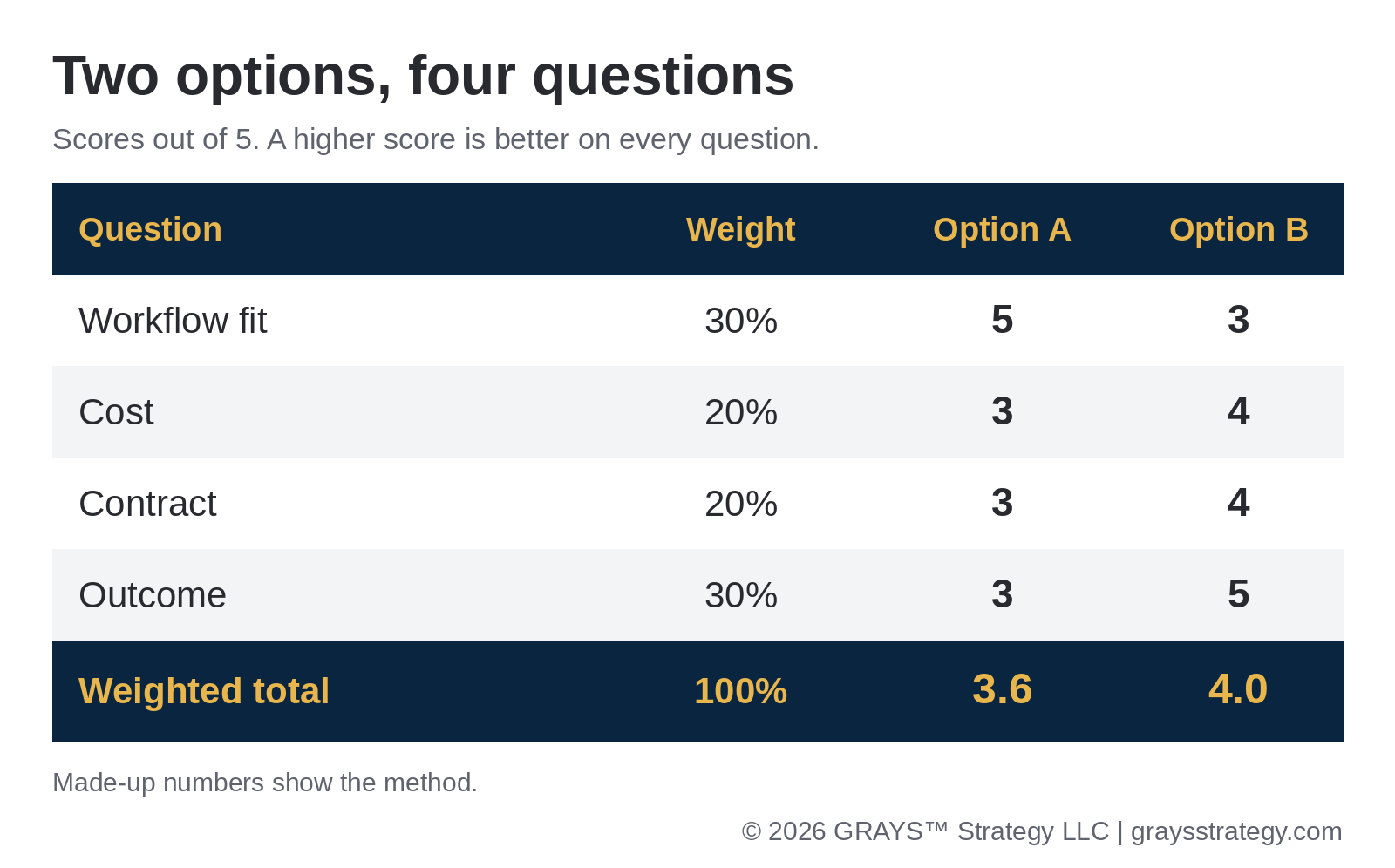
Figure 1. Made-up example: weights and scores out of 5 for two options.
Option B scores higher, 4.0 to 3.6. Now change the weights to workflow fit 50%, cost 20%, contract 10%, and outcome 20%. The scores stay the same, and Option A now leads, 4.0 to 3.7.
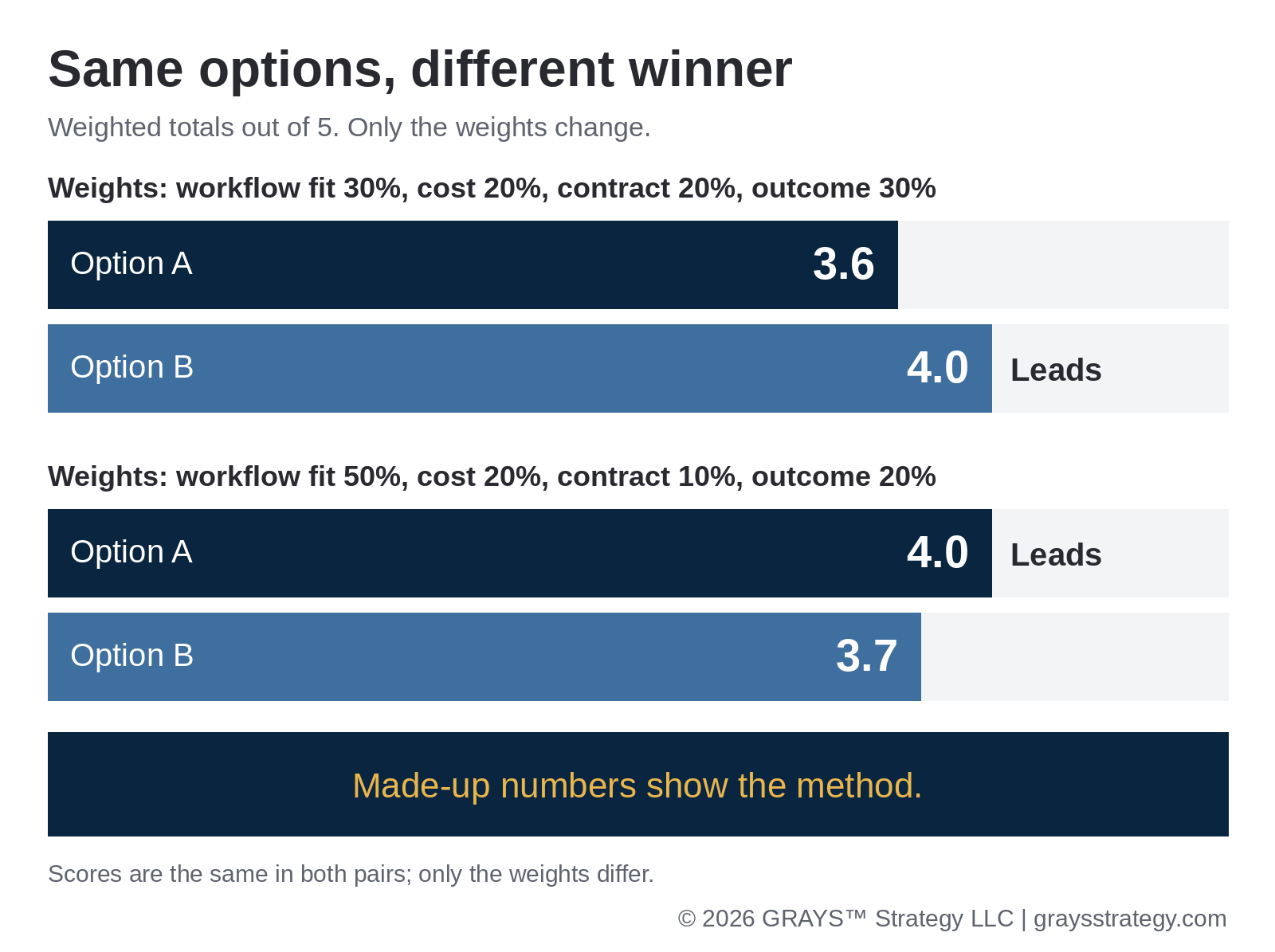
Figure 2. Made-up example: the same two options rank differently when the weights change. Made-up numbers show the method.
The example gives workflow fit its own row. Task-technology fit is about whether the technology is suitable for the work that people are doing. In health care, a 2025 meta-analysis of 15 studies found fit to be associated with intention to use the technology (Thanthrige et al., 2025). Intention is not use, so treat it as a signal and check for actual use on your first look back.
This example uses four variables so the method stays easy to follow. We believe a decision this important deserves a more thorough review. Some research frameworks for health technology go further. For example, the NASSS framework for nonadoption, abandonment, scale-up, spread, and sustainability poses questions across seven domains (Greenhalgh et al., 2017).
Read the results against the baseline
Set a date to look back, for instance 90 days after go-live, and again at 180 days. Compare each outcome with its baseline. The first read shows whether the technology is moving things the way you agreed, and the second shows whether the change holds.
Which outcome would you want to move first?
Agreeing on outcomes that fit your organization is often the hardest step.
We design strategy for your specific reality. If you’d like to talk through how this applies to your organization, we’re glad to start with a short conversation: info@graysstrategy.com.
Share this article on LinkedIn
References
Greenhalgh, T., Wherton, J., Papoutsi, C., Lynch, J., Hughes, G., A’Court, C., Hinder, S., Fahy, N., Procter, R., & Shaw, S. (2017). Beyond adoption: A new framework for theorizing and evaluating nonadoption, abandonment, and challenges to the scale-up, spread, and sustainability of health and care technologies. Journal of Medical Internet Research, 19(11), e367. https://doi.org/10.2196/jmir.8775
Patel, S. B., Iqbal, F. M., Lam, K., Acharya, A., Ashrafian, H., & Darzi, A. (2025). Characterizing behaviors that influence the implementation of digital-based interventions in health care: Systematic review. Journal of Medical Internet Research, 27(1), e56711. https://doi.org/10.2196/56711
Thanthrige, A., Lu, B., Sako, Z., & Wickramasinghe, N. (2025). Determinants of health care technology adoption using an integrated unified theory of acceptance and use of technology and task technology fit model: Systematic review and meta-analysis. Journal of Medical Internet Research, 27(1), e64524. https://doi.org/10.2196/64524
GRAYS™, GRAYS Method™, and Clarity in Complexity™ are trademarks of GRAYS™ Strategy LLC. © 2026 GRAYS™ Strategy LLC. All rights reserved. This content reflects general commentary and professional analysis current as of its publication date. It does not constitute legal, regulatory, financial, or compliance advice, and should not be relied upon as a substitute for professional counsel specific to your organization’s circumstances. Regulatory developments referenced herein may change after publication; readers should verify current status independently before acting.
More from Clarity Defined