This article presents only general professional opinions and does not constitute legal, regulatory, financial, or compliance advice relating to your particular case. Reading it creates no consulting relationship with GRAYS™ Strategy. Figures come from the sources cited, as of the publication date, so please check them before you rely on them.
The phrase "diversify your revenue" appears in almost all strategic plans prepared by nonprofit organizations providing health and human services. In reality it generally amounts to nothing more than applying for more grants. Although it may appear diversified on a spreadsheet when you have a federal grant, a state contract, and two foundation grants, the actual funding approach is the same, merely divided among a greater number of line items rather than constituting a second revenue model.
What does "diversifying" actually mean at most organizations?
Researchers have distinguished among types of nonprofit revenue for decades, including private contributions, government funding, and commercial income like fees and program revenue (Froelich, 1999). Adding a third grant to a portfolio that already has two doesn’t bring in commercial income. It’s the same kind of payment, just sourced from a different funder, carrying the same underlying vulnerability. Whatever made that funding category unstable in the first place is still there. It’s just wearing a new name on the check.
Does concentrated funding actually carry more risk?
It isn’t always the case, and this point is one that conventional advice often omits. An empirical study of nonprofit revenue portfolios found that, for organizations relying on government grants, higher revenue concentration was associated with lower portfolio risk. For organizations relying on donations, the pattern ran the other way (Qu, 2019). Another study, of a large sample of U.S. nonprofits, found that organizations with highly concentrated revenue spent less on administration and fund-raising, but faced greater exposure to swings in their financial position (Frumkin & Keating, 2011). Diversification does not automatically constitute the safer option. What matters is what distinct areas you’re actually diversifying into.
What’s actually at stake right now?
This isn’t an abstract debate. The federal reconciliation package signed into law in 2025 cuts federal Medicaid spending by an estimated $911 billion over the next ten years, according to the Congressional Budget Office (KFF, 2025). That’s exactly the kind of shock a grants-only diversification strategy does nothing to protect against, since Medicaid dependency and grant dependency were never the same category of risk to begin with. Stacking more of one doesn’t insulate an organization from the other.
What does a genuinely different revenue model actually look like?
The principle underlying the second grant is the same as that of the first: you have to apply, wait, give a report, and then renew, no matter which funder actually issues the payment. Genuine difference in a revenue source can only be achieved if there is some real change. This involves not just having a different funder within the existing grant system, but rather a completely different type of entity. The method of payment also makes a difference: it should be fee-for-service, value-based, or a blended rate rather than another discretionary award. The key indicator is what actually causes the money to be paid: it has to be a service that has been provided, not just a proposal that happened to be approved. Contracts with managed care organizations operate on this basis; so do licensing fees for a curriculum or methodology that the organization has already developed, or a blended-rate agreement with a health system partner. None of these arrangements earn money for the same reason a grant does.
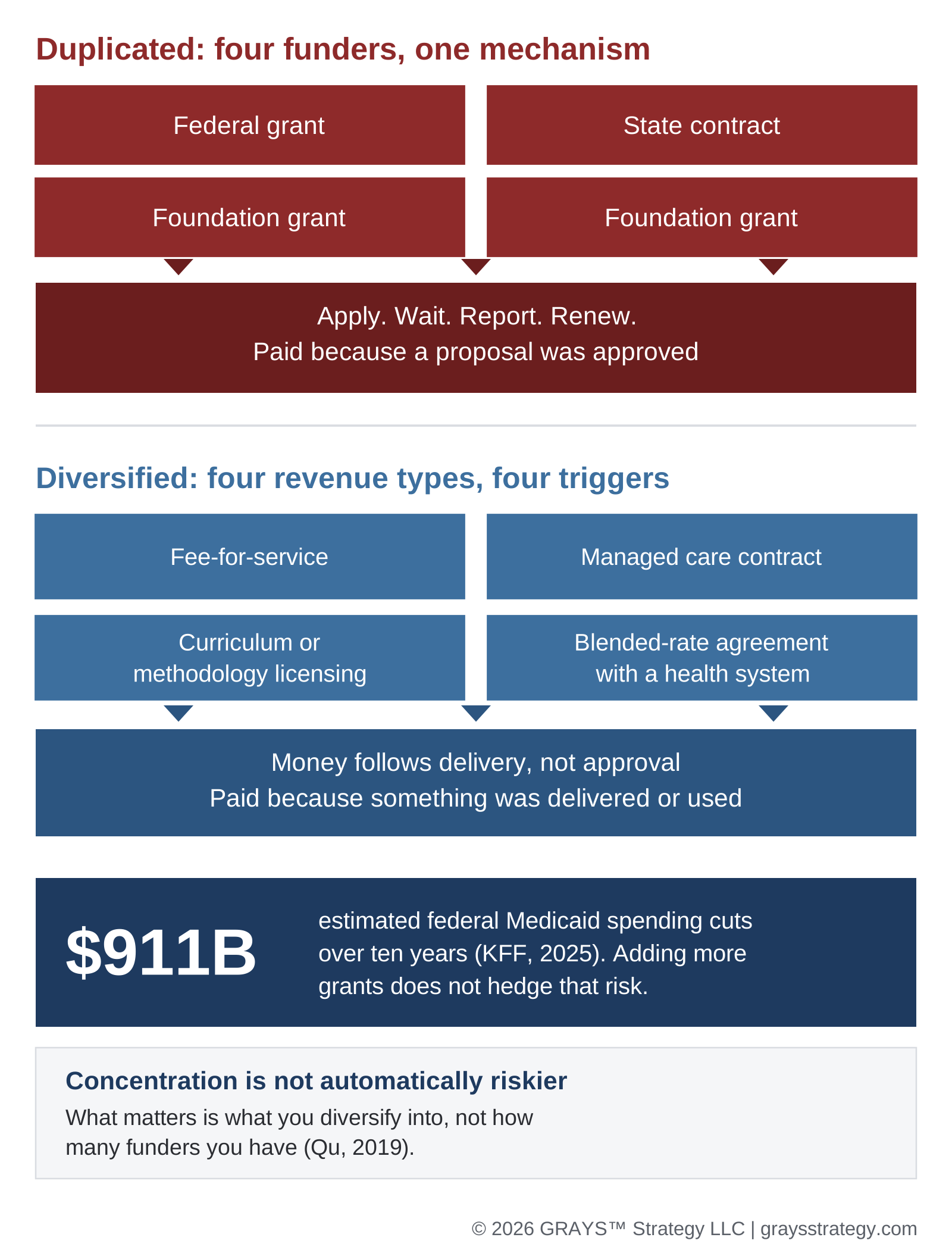
Figure 1. Illustrative comparison of revenue mechanisms. Sources: Froelich (1999); Frumkin & Keating (2011); KFF (2025); Qu (2019).
Most strategic plans that list "diversify revenue" as a goal never actually say which of those things is supposed to change. Naming it is the real test. A plan that can’t name it is describing a second grant application and calling it something else.
Questions about how this applies to your organization? Reach out at info@graysstrategy.com.
Share this article on LinkedIn
References
Froelich, K. A. (1999). Diversification of revenue strategies: Evolving resource dependence in nonprofit organizations. Nonprofit and Voluntary Sector Quarterly, 28(3), 246–268. https://doi.org/10.1177/0899764099283002
Frumkin, P., & Keating, E. K. (2011). Diversification reconsidered: The risks and rewards of revenue concentration. Journal of Social Entrepreneurship, 2(2), 151–164. https://doi.org/10.1080/19420676.2011.614630
KFF. (2025, July 23). Allocating CBO’s estimates of federal Medicaid spending reductions across the states: Enacted reconciliation package. https://www.kff.org/medicaid/allocating-cbos-estimates-of-federal-medicaid-spending-reductions-across-the-states-enacted-reconciliation-package/
Qu, H. (2019). Risk and diversification of nonprofit revenue portfolios: Applying modern portfolio theory to nonprofit revenue management. Nonprofit Management and Leadership, 30(2), 193–212. https://doi.org/10.1002/nml.21385
Cited research reflects the best available evidence at time of writing, including findings drawn from adjacent industries and organization types.
GRAYS™, GRAYS Method™, and Clarity in Complexity™ are trademarks of GRAYS™ Strategy LLC. © 2026 GRAYS™ Strategy LLC. All rights reserved. This content reflects general commentary and professional analysis current as of its publication date. It does not constitute legal, regulatory, financial, or compliance advice, and should not be relied upon as a substitute for professional counsel specific to your organization’s circumstances. Regulatory developments referenced herein may change after publication; readers should verify current status independently before acting.
More from Clarity Defined